- Sep 14
- Par Pecron LLC

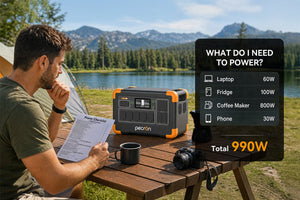
A portable power station can run a device for anywhere from less than an hour to several days. The useful estimate comes from three numbers: the battery capacity in watt-hours (Wh), the device's average power draw in watts (W), and the energy lost during conversion.
As a quick example, a 1,000Wh power station can run a steady 100W AC load for about 8.5 hours when you use an 85% planning factor. A refrigerator, CPAP machine, or other cycling device may last longer or shorter because its power draw changes during use.
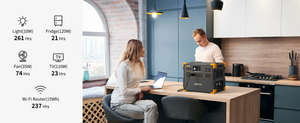
Below, you will find a portable power station runtime chart, a simple formula, and practical examples for refrigerators, laptops, CPAP machines, coffee makers, and induction cooktops.
How to Calculate Portable Power Station Runtime
For a steady AC load, use this formula:
Estimated runtime (hours) = Battery capacity (Wh) x 0.85 / Average load (W)
The 0.85 factor allows for inverter and system losses. It is a useful planning assumption, not a guaranteed efficiency rating for every device or operating condition.
For example, a 1,024Wh power station running a 120W device would have an estimated runtime of:
1,024Wh x 0.85 / 120W = 7.25 hours
Without the efficiency factor, the theoretical result would be 8.53 hours. The adjusted number is more useful when planning around an AC outlet.
Portable Power Station Runtime Chart
The estimates below use each model’s rated battery capacity and an 85% usable-energy factor for continuous AC loads.
|
Device |
Planning load |
E1000LFP |
F3000LFP |
F5000LFP |
|
CPAP machine |
40W |
~21.8 hr |
~65.3 hr |
~108.8 hr |
|
Portable refrigerator |
60-120W average |
~7.3-14.5 hr |
~21.8-43.5 hr |
~36.3-72.5 hr |
|
Laptop |
60W |
~14.5 hr |
~43.5 hr |
~72.5 hr |
|
Portable projector |
65W |
~13.4 hr |
~40.2 hr |
~67.0 hr |
|
Coffee maker |
1,000W |
~52 min |
~2.6 hr |
~4.4 hr |
|
Induction cooktop |
1,500W |
~35 min |
~1.7 hr |
~2.9 hr |
Planning note: Actual runtime varies with device efficiency, startup demand, duty cycle, temperature, battery state of charge, battery age, and the outputs used. Refrigerator estimates must use average consumption, not only the rated running wattage.
Why Actual Runtime Is Different From the Formula
Inverter and Standby Losses
AC appliances require the power station's inverter to convert battery DC power into AC power. That conversion uses energy, and the inverter itself may consume a small amount while it is on. The 85% factor accounts for these losses at a practical planning level, although efficiency changes with the load.
Average Load and Duty Cycle
Many appliances do not draw their rated wattage continuously. A refrigerator compressor cycles on and off. A CPAP machine may use more power when heated humidification or heated tubing is enabled. For these devices, average consumption over time is more useful than a single label value.
Starting or Surge Power
Runtime is only half of the sizing question. Compressors, pumps, and some power tools may briefly draw far more power when they start. The power station must have enough continuous and surge output to start the appliance, even if the battery stores enough energy to run it for the desired period.
Temperature and Battery Condition
Cold weather can reduce available battery performance, while very hot conditions can trigger protective limits or increase cooling demand. Battery age, state of charge, and the power station's internal settings also affect the result.
AC Versus DC Output
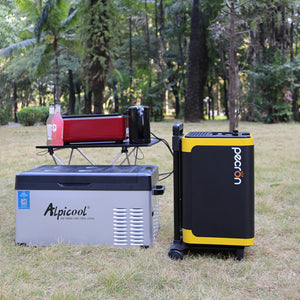
A compatible 12V refrigerator or other DC device can avoid DC-to-AC conversion. This may improve runtime, but the benefit depends on the device, cable, voltage regulation, and the power station's own DC conversion efficiency.
How Long Will a Portable Power Station Run a Refrigerator
Refrigerator runtime varies widely because the compressor does not run all the time. Room temperature, door openings, thermostat setting, food load, and the refrigerator's insulation all affect average consumption.
If a refrigerator averages 120W, a 1,024Wh power station gives this planning estimate:
1,024Wh x 0.85 / 120W = 7.25 hours
If the same refrigerator averages 60W after compressor cycling is taken into account, the estimate becomes:
1,024Wh x 0.85 / 60W = 14.5 hours
For a more accurate result, measure the refrigerator with a plug-in energy meter over 24 hours. You can also review our guide to choosing a portable power station for a refrigerator for help with running watts, startup demand, and backup duration.
Estimated Runtime by PECRON Model
E1000LFP for Camping and Essential Devices
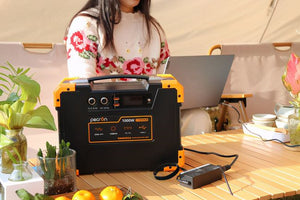
The PECRON E1000LFP combines a 1,024Wh battery with 1,800W rated AC output. It is suited to CPAP use, laptops, portable refrigerators, mobile work, and shorter backup periods. Its 12V 20A output can also support compatible DC equipment.
At a steady 60W AC load, the 85% formula gives about 14.5 hours. At 1,000W, the same battery provides about 52 minutes before other real-world variables are considered.

F3000LFP for RV Trips and Longer Backup
The PECRON F3000LFP provides 3,072Wh of capacity and 3,600W rated AC output. It fits longer camping trips, RV use, emergency backup, and higher-power appliances. Compatible expansion batteries can increase its total stored energy when longer runtime is the priority.

Approximate F3000LFP runtime for selected continuous AC loads
F5000LFP for Extended Home Backup
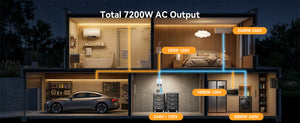
The PECRON F5000LFP stores 5,120Wh and supports up to 7,200W output in its 120V/240V configuration. It is designed for longer outages, demanding work sites, and backup systems that need to operate several appliances. Its storage can be expanded when the base battery is not enough for the required backup period.

Approximate F5000LFP runtime for selected continuous AC loads
Capacity and output answer different questions. Watt-hours determine how long energy can last; watts determine what the unit can run at one time.
How Solar Panels Change Runtime
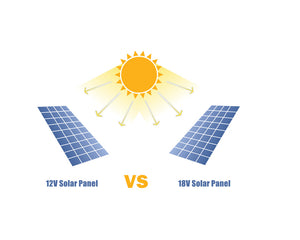
Solar panels can extend runtime by replacing some or all of the energy your devices consume. They do not make runtime unlimited by themselves. The result depends on daily energy use and how much solar energy reaches the battery after weather and conversion losses.
A steady 100W load consumes 2,400Wh in 24 hours. To maintain the battery level, the solar array must produce at least that much usable energy each day. Panel rating alone is not enough; shading, panel angle, cloud cover, temperature, daylight hours, and charging limits all affect daily production.
When planning an off-grid setup, compare battery capacity, daily consumption, and expected solar harvest together. Browse PECRON solar generator kits to compare power stations with compatible solar-panel options.
Ways to Extend Portable Power Station Runtime
Measure the real load. Use a watt meter or the power station display to check actual consumption instead of relying only on the appliance label.
Use DC for compatible equipment. A direct DC connection may reduce conversion losses when the voltage and connector are correct.
Limit heating appliances. Coffee makers, kettles, microwaves, space heaters, and induction cooktops can consume a large share of the battery in a short time.
Turn off unused outputs. Disable AC or DC circuits that are not needed, especially during long low-load periods.
Recharge during the day. Solar input or vehicle charging can replace part of the energy used during a trip.
Add compatible expansion batteries. Extra battery capacity extends runtime; it does not increase appliance compatibility unless the system specifications also provide more output.
Choosing the Right Capacity
Start with the appliances you need to run, their average wattage, and the number of hours they must operate. Add the energy required by each device, then include a reasonable reserve for conversion losses and changing conditions.
Required battery capacity (Wh) = Total daily energy use (Wh) / Planning efficiency
Once you know the capacity and output you need, compare the full range of PECRON portable power stations by battery size, rated output, charging options, and expandability.
Frequently Asked Questions
How long will a 1,000Wh power station run a 100W device?
The theoretical runtime is 10 hours. Using an 85% planning factor for a continuous AC load gives about 8.5 hours. Actual runtime depends on the power station, device, temperature, and operating conditions.
How long will a 1,000Wh power station run a refrigerator?
It depends on the refrigerator’s average consumption. At a 60W average load, the estimate is about 14.2 hours using a true 1,000Wh capacity. At 120W, it is about 7.1 hours. Startup demand must also remain within the power station’s surge capability.
How long will a portable power station run a CPAP machine?
A 1,024Wh power station can run a steady 40W CPAP load for about 21.8 hours using the 85% planning factor. Heated humidification and heated tubing can increase consumption and shorten runtime.
Does a higher watt rating mean longer runtime?
No. The watt rating shows how much output the power station can supply. Battery capacity in watt-hours is the main number used to estimate runtime.
Can solar panels keep a power station running indefinitely?
Only when usable solar production consistently matches or exceeds total energy use. Weather, daylight, panel placement, and charging limits can prevent that balance.
Does DC output provide longer runtime than AC?
It can for compatible devices because it avoids the main DC-to-AC inverter stage. Actual savings depend on the device and the power station’s DC conversion system.